
Category Archives: Essays
East Sacramento Writer Clarifies Community Power and Grassroots Democracy: NIMBY vs. DIMBY
NIMBY vs. DIMBY
by Pat Lynch
The term NIMBY (Not In My Back Yard) has become a common pejorative, used most often to depict people who oppose development that they believe degrades the quality of neighborhood life. NIMBYS live in a variety of older houses on generally quiet streets. DIMBYS, (Development In My Back Yard) on the other hand, scorn NIMBYS, and yearn for new, spacious dwellings with warehouse-sized garages to park their Land Rovers. They long to buy into new developments containing expansive houses with much ballyhooed “modern amenities.”
The proposed McKinley Village project has fired up both groups. NIMBYS in East Sac and Midtown dread the traffic assault that will overwhelm them if developers blast through the levee to funnel thousands more cars daily into their streets. Developers say they’re not blasting through the levee, they’re blasting through the “embankment.” But blasting through is blasting through, the NIMBYS say, no matter what you call the target. Some of the kindlier, more humane NIMBYS fear that DIMBYS might be flooded or otherwise injured if they live in a bowl with a railroad and freeway spewing toxins from the rim. But DIMBYS appear to be fearless. Some of them say NIMBYS are old and don’t want to see a newer generation enjoy the good life. (You can find some of these unmannerly DIMBYS assertions on the East Sacramento Preservation Neighborhood Association Facebook page). One developer advocate told several NIMBYS who protested traffic explosion, “You live in an urban world. Deal with it.”
The developer, the DIMBYS and the City all reverently refer to the McKinley project as “infill,” and “smart growth.” But NIMBYS ask, how smart is infill that spills out into neighboring communities, thus creating traffic hazards and lowering property values? How smart is infill that creates outspill? While we ponder these matters pro-development lawyers try to change CEQA laws so that ‘obstructionist’ NIMBYS can’t sue “on aesthetic grounds” (that is, when oversized, overbuilt structures are wedged into small infill vacancies. The infamous twenty pounds of potatoes in a ten-pound sack comes to mind.
In this controversy I come down on the side of the NIMBYS. Old? No. I don’t consider myself old until I live in a group home with people whose names I can’t remember. Obstructionist? Sure, if I’m obstructing something I perceive as harmful. But to be certain about these matters, I researched the principles of smart growth and urban infill. One of the requirements is “compact building design.” I live in a compact house. Several McKinley Village houses will have three car garages. Another smart infill requirement is that it “provide a variety of transportation choices.” I live around the corner from the bus stop. The Prius sits in the driveway. The bike is in the den. We don’t know yet what shuttle service or bus line service the developers will present.
Megan Norris, Vice President of Riverview Capital Investment which funds the proposed McKinley Village, said there was “strong demand from residents in existing city neighborhoods for homes with modern… amenities.” Modern amenities? In my compact house I was able to plug in an electric car in a regular outdoor outlet. Central heat and air conditioning work efficiently in this bungalow built in 1920. So does every other modern amenity—desktop, laptop, iPad, iPhones,–you name it, I plug it in. I realized as I read that this house meets infill standards. My neighbors and I are what it’s all about. We can walk to Starbucks or the drug store. We can walk or bike to Corti Brothers or McKinley Park. And we do. Many take the J Street bus to downtown jobs.
We’re good NIMBYS. We work. We vote. We attend civic meetings. We support charities. We have Neighborhood Watch. We cherish the trees and flowers and recognize that ours is a classic, fragile environment. We care for one another. On my block alone seven people have Environmental Respiratory Disease, so we worry about auto exhaust and traffic increase that threatens the safety of our kids and the health of our lungs. We don’t like being told we’re anti-progress simply because we try to define the term.
The developers stay on message, say the same thing over and over in the expectation that it will somehow morph into accepted doctrine. But this doesn’t work with us. We don’t like being told that the fix in and things are “done deals.” We don’t like being told that we’d better accept this proposal because it’s the best we’ll get. It’s not. And this is what we say to the person who said, “You live in an urban world. Deal with it.” Here’s how we deal with it. We calm traffic and oppose its increase. And we resist perilous infill projects that turn stable neighboring areas into collateral traffic damage.
It’s sane and progressive to fight to preserve Midtown and East Sacramento. It’s right to resist car-centric projects that will foul our air and engulf us in traffic. Ad hominem Dimby attacks won’t deter us. We have, as they note, been around the block. Right now McKinley Village doesn’t seem to us like smart growth at all. It seems more like Phoenix.
McKinley Village Fails to Impress Skeptical East Sacramento and Midtown Crowd
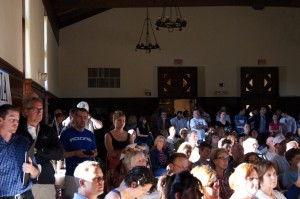 East Sacramento residents were tetchy last night and not completely on their best behavior. However, rowdy crowds grow quiet when given clear and complete answers. That didn’t happen last night.
If a developer proposes to change the character of two established neighborhoods he either needs to come to the neighborhood with a blank slate and build from there or bring a flushed out plan to the table and be ready to negotiate. A firm handle on public transportation, landscaping, architectural continuity with existing neighborhood homes, density and traffic issues is a must. Starting an application process before you understand what the neighborhood can tolerate is not a good start.
While urban density is preferred, it can’t come at the expense of air quality and traffic management. If developer Phil Angelides takes a second look at his plan he might create a project that East Sacramento and Midtown can tolerate. He knows where to begin–he got an earful of suggestions to ponder.
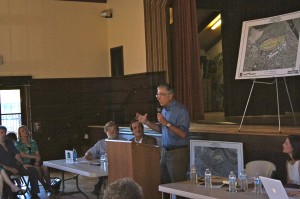 Come back to the table Mr. Angelides. Refresh your plan so it doesn’t punish the neighborhoods. If you want to calm tempers and lessen anxiety start with reassessing the density, number of vehicle entries, three car garages and lack of low-income housing. Be mindful that the traffic increase your plan imposes on East Sacramento and Midtown is rightly perceived as an enormous burden.
Has East Sacramento Preservation Neighborhood Association prejudged this project? No, we have not. We have not published an opinion of the project, just asked hard questions. The neighborhood will be ready to listen if its concerns are seriously addressed.
Here are the general responses the development team gave on important topics:
Traffic Issues
What are the geographic boundaries of the traffic study? Not answered.
Can the plan have three well-designed car traffic access points? Not possible for technical reasons. Developer was not given time to answer this fully.
Has no plans for traffic mitigation.
Maintains urban environments must deal with traffic.
Flood Threats
General response: railroad never intended as a second levee, no flood insurance required in the area, 100 year flood protection, maybe more in the future.
Storm and Sewer Runoff
Developer maintains that the area will be self-contained and will not burden the East Sacramento or Midtown systems.
Regional Transit Access Issues
Maintains that bus line exists within walking distance. Plans to work with RT.
Landscaping
Plans to have leafy canopies, no specific plan or research in place.
Schools
Application in to SCUSD and Twin Rivers to rezone the area to SCUSD.
Developer’s Model for Dealing with Concerns
Will continue to hold meetings with neighborhood groups. Frowned on negative comparison to Stonebridge/Sutter Memorial developer’s community outreach. Did not state any intent to change communication/interaction model with neighbors.
Posted in Essays, Uncategorized
Comments Off on McKinley Village Fails to Impress Skeptical East Sacramento and Midtown Crowd
 Check Us Out On Facebook!